In the fibreglass vs rubberoid roof debate, both fibreglass (GRP) and rubber (EPDM) are excellent long-life choices for a flat roof, and both far outlast old-style felt. Fibreglass is tougher and better if the roof will be walked on. Rubber is quieter, quicker to lay and copes better with movement. For most loft dormer roofs, either works well, as long as it is installed properly over a well-insulated roof.
At City Lofts we use both, choosing whichever suits the roof.
| Fibreglass (GRP) | Rubber (EPDM) | Felt (torch-on or Ruberoid) | |
|---|---|---|---|
| What it is | Resin and glass-fibre matting laid wet and set hard | A single sheet of synthetic rubber | Layers of bitumen felt, heat-bonded together |
| Typical lifespan | 25–30+ years | 30+ years | 15–25 years for modern three-layer felt |
| Cost | Medium to high | Medium | Lowest |
| Joints | Seamless | One sheet on most small roofs | Overlapping layers |
| Walking on it | Tough and walkable | Can be punctured | Can be damaged |
| Noise | Can creak as it heats and cools | Quiet | Quiet |
| Weather to install | Needs dry, mild weather to set | Can be laid in most weather | Uses a gas torch, so there is a fire risk near timber |
| Best for | Roofs that will be walked on, complex shapes | Dormer roofs and simple flat roofs | Garages, sheds and tight budgets |
What is a rubberoid roof?
“Rubberoid” is one of the most confusing words in roofing, because people use it for two different things:
- Felt roofing. Ruberoid is a long-established brand of bitumen roofing felt, and many builders still call any felt roof “rubberoid”.
- Rubber roofing. Many homeowners say “rubberoid” when they mean a modern rubber roof, made from a material called EPDM.
They are very different products. Old-style felt, especially cheap one- or two-layer felt, can start leaking within a few years. A modern EPDM rubber roof can last decades. So if a quote says “rubberoid”, ask exactly which material it means.
This guide compares all three options: fibreglass, rubber and felt.
Fibreglass (GRP) roofs: pros and cons
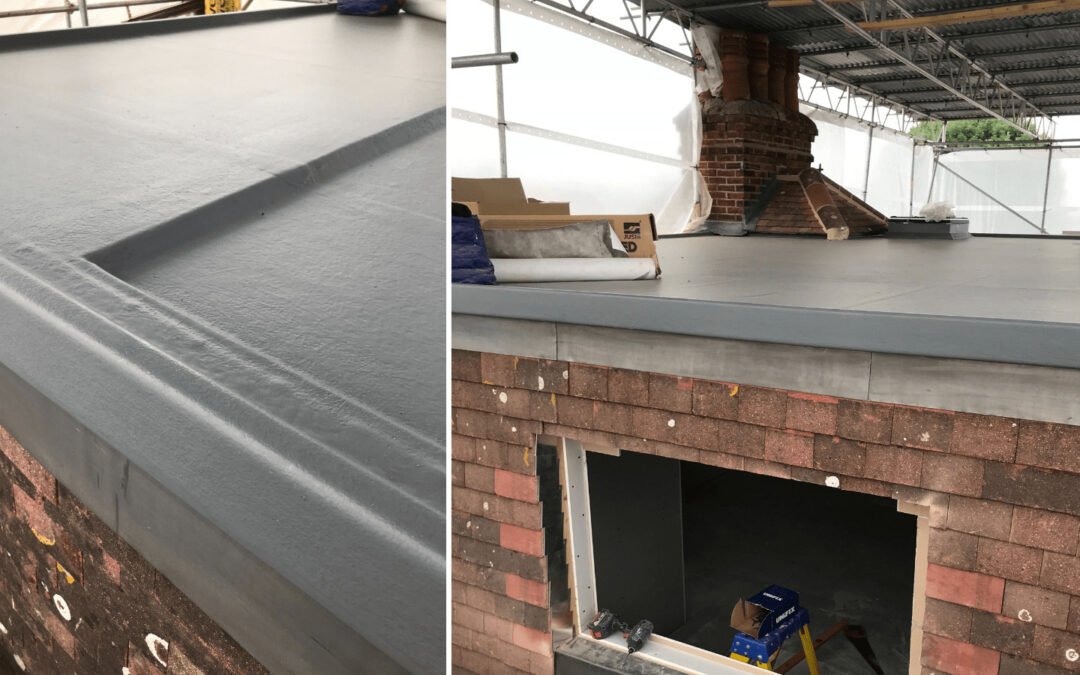
A fibreglass roof, also called GRP (glass-reinforced plastic), is made by laying resin and glass-fibre matting over a timber deck. Once it sets, it forms one hard, seamless, waterproof layer, finished with a coloured topcoat.
Pros
- Very durable: a well-laid GRP roof typically lasts 25–30 years or more.
- Seamless: no joints for water to get through.
- Strong and walkable: it copes well with occasional foot traffic, such as maintenance access.
- Neat finish: it can be shaped around rooflights, upstands and awkward corners, and comes in different colours.
Cons
- Weather-dependent: the resin needs dry, mild conditions to set properly, which can delay work in a British winter.
- Can creak or crack: GRP expands and contracts with temperature. If it is laid badly, or on a deck that moves, it can crack and make noise.
- Quality depends on the installer: mixing and laying need skill, and a poor job is hard to put right.
Rubber (EPDM) roofs: pros and cons
An EPDM rubber roof is a single sheet of synthetic rubber bonded to the roof deck. On most dormer roofs, one sheet covers the whole surface with no joints.
Pros
- Long life: a good EPDM roof can last 30 years or more.
- Flexible: it stretches with the building’s natural movement and temperature changes, so it doesn’t crack.
- Quiet: no creaking, and rain is quieter than on GRP.
- Quick to install: it can be laid in most weather, which helps keep a loft build on schedule.
Cons
- Can be punctured: sharp objects or heavy foot traffic can damage it, so it’s less suited to roofs people walk on.
- Plain look: the matt black finish is practical rather than attractive. That rarely matters on a dormer roof nobody sees.
- Detailing matters: the edges and corners around rooflights and upstands need careful sealing.
Felt roofs: pros and cons
Felt roofs are layers of bitumen felt bonded together, usually with a gas torch (torch-on felt). Modern high-performance three-layer felt is far better than the cheap one- or two-layer felt that gave flat roofs a bad name.
Pros
- Lowest cost of the three.
- Familiar: most roofers can repair it.
Cons
- Shorter life: typically 15–25 years for good three-layer felt, and far less for cheap felt.
- Fire risk during installation: the gas torch is a hazard near timber, which is one reason many builders avoid it on lofts.
- Ageing: sunlight and temperature changes make felt brittle over time, leading to cracks and leaks.
Which flat roof is best for your project?
| Loft conversion dormer roof | EPDM rubber or GRP fibreglass | Both last decades; EPDM is quick and quiet, GRP gives a harder finish |
| Mansard loft (flat top) | EPDM rubber or GRP fibreglass | The top is rarely walked on, so either works well |
| Rear or side extension | GRP fibreglass or EPDM | GRP suits roofs with rooflights or lanterns and complex shapes |
| Garage or shed | EPDM or good three-layer felt | Lower cost matters more on outbuildings |
For a loft conversion, we would steer you away from cheap felt. A failed roof over a new bedroom costs far more to fix than the saving at the start. See our guide to loft conversion mistakes and our dormer loft conversions page.
What matters more than the covering
The roof covering is only the top layer. Whichever material you choose, these matter just as much:
- Insulation: Building Regulations set high insulation standards for new roofs. Most new flat roofs are built as a “warm roof”, with insulation above the deck and below the covering, which keeps the room below comfortable and avoids condensation.
- Falls: a “flat” roof should be built with a slight slope so rainwater drains away rather than pooling.
- The installer: most flat roof failures come from poor installation, not the material. Ask who will lay the roof, and how much experience they have with that system.
- The guarantee: ask how long the guarantee lasts and who backs it, the installer or the manufacturer.
Planning a loft or extension? We can visit, look at your roof and tell you which option suits it.
Fibreglass vs rubberoid roof: frequently asked questions
Is fibreglass or rubber better for a flat roof?
Both are good long-term choices. Fibreglass (GRP) is tougher and better for roofs people walk on, or for complex shapes. Rubber (EPDM) is quieter, more flexible and quicker to install. For a typical loft dormer, either works well if it is installed properly.
How long does a fibreglass roof last?
A well-installed GRP fibreglass roof typically lasts 25–30 years or more. Poor installation, or laying it in the wrong weather, can shorten that considerably.
How long does a rubber roof last?
A good-quality EPDM rubber roof can last 30 years or more. It needs very little maintenance beyond keeping gutters and outlets clear.
Is rubberoid the same as felt?
Often, yes. Ruberoid is a brand of bitumen roofing felt, and many builders call any felt roof “rubberoid”. But some people use the word for EPDM rubber roofs, so always ask exactly what material a quote includes.
Why is my fibreglass roof making cracking noises?
GRP expands and contracts as it heats up and cools down, which can cause creaking, especially on warm days. Occasional noise is normal. Loud cracking, or visible cracks, can mean the roof was laid badly or the deck underneath is moving, so get it checked.
Which is cheaper, fibreglass or rubber?
Felt is the cheapest of the three. EPDM rubber and GRP fibreglass usually cost a similar amount, with fibreglass often slightly more because it takes longer to lay. The difference is small compared with the cost of fixing a failed roof.
Get the right roof on your loft first time
The fibreglass vs rubberoid roof choice is one of many details that decide how well your loft conversion lasts. We design and build lofts across London with long-life flat roofs, insulated to current Building Regulations. Tell us about your project and we’ll recommend the right roof for it, with no obligation.